
Kitchen alternatives to tiles? Ceramic remains a timeless classic, especially in the one room where function and style matter most. But it's no longer the only option for kitchen walls. In recent years, interior design has experimented with alternative materials that combine style, durability, and personalisation: porcelain stoneware, resin, natural stone, glass, metal, wood, and of course wallpaper. Here are 7 alternatives to tiles for kitchen walls, from the backsplash to the dining wall.
Renovate your kitchen with waterproof fibreglass wallpaper. Get a free simulation from our design team.
Why people are moving away from tiles
Tile's strengths are well known: it resists knocks, scratches, humidity and heat, doesn't stain, and cleans easily with almost any household product — which is exactly why it's still the standard even in professional kitchens. But those same technical qualities come with a trade-off: a rigid visual grid, always-visible grout lines, and formats and patterns that are often fairly standardised.
Anyone after a more continuous, seamless, or custom result increasingly looks at alternatives instead. Each material has its own trade-offs: the right choice depends on budget, kitchen style, and which wall you're covering — a backsplash behind the stove has very different demands from a dining wall.
1. Porcelain stoneware in large slabs
Porcelain stoneware is probably the closest alternative to traditional tile in terms of performance: it holds up extremely well against water, heat, and scratches, and comes in large-format slabs that drastically cut down on visible grout lines compared to standard tiles. Marble, concrete, or stone-effect finishes suit both modern and minimal kitchens. It does require professional installation, though, and the weight of large slabs makes it a more involved job than most other options here.
2. Resin
Resin is applied directly to the wall (even over existing tiles, avoiding demolition) to create a fully continuous surface with no grout lines or joints. It's customisable in colour and finish — matte, glossy, textured — and easy to keep clean. It needs a professional applicator and proper drying time, and tends to sit at a higher price point than most alternatives on this list.
3. Natural or engineered stone
Natural stone is one of the more striking choices, particularly with materials like travertine, Carrara marble, or granite. In the kitchen, you can cover the whole wall behind the stove or just the backsplash. The lack of grout lines makes it easy to clean, but it does require care with the products used for maintenance, and cost is a real factor — it's one of the priciest options here.
4. Glass (including backlit panels)
Glass means timeless design, and in small kitchens it's also a functional choice: it lets light pass through and bounce off surfaces, making the space feel larger and brighter. In the kitchen, always go for treated glass that resists scratches and knocks. To avoid an "aquarium effect," pair it with other materials or printed decoration, or consider a backlit panel for a stronger visual statement.
5. Stainless steel
Prized for durability and looks, stainless steel suits contemporary kitchens well. Contrary to what people often assume, a steel backsplash is actually a smart choice: being non-porous, it's easy to clean, holds up well to heat, and is hard to damage. It lasts a long time even with minimal upkeep, as long as you avoid harsh cleaning products — ammonia or strong acids can stain the surface.
6. Wood
Durable, eco-friendly, and long-lasting, wood comes in a range of finishes — oak, pine, and walnut are the most common. It's still not the default choice for kitchens in many markets, but it's increasingly popular in rustic or mountain-style homes. It also works in more urban settings: to avoid a "cabin" look, wood pairs well with other materials, for example combining a wood upstand with a rustic or minimal wallpaper for contrast.
7. Washable wallpaper
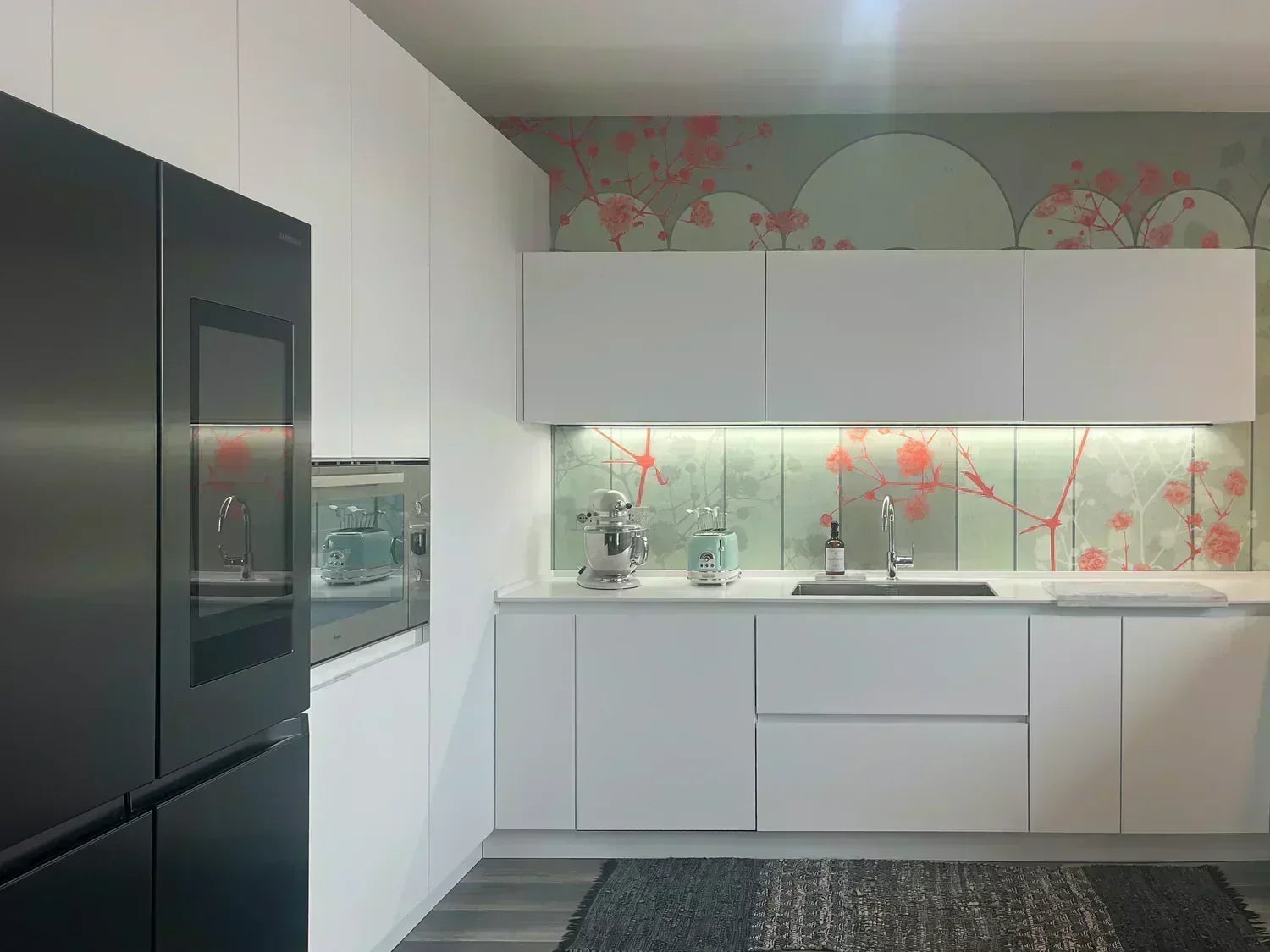
The last of the 7 alternatives — and arguably the most customisable — is washable wallpaper. This isn't old-fashioned paper: it's a genuine decorative covering on high-performance materials, either vinyl on a non-woven backing or resin-treated fibreglass, which also handles humid environments well. It brings botanical patterns, marble-effect textures, artistic illustrations, or geometric designs into the kitchen — a decorative element that can define the whole room, even on a single wall.
The main advantage is personalisation: material, colours, finish, proportions, and style can all be tailored precisely to the room. For a full breakdown of which type to choose and how to keep it looking good, see our guide to washable wallpaper for the kitchen.
Comparison table: 7 alternatives at a glance
| Material | Heat & water resistance | Maintenance | Design flexibility | Installation complexity |
|---|---|---|---|---|
| Porcelain stoneware | High | Low (few grout lines) | Medium | High (professional install) |
| Resin | High | Low (seamless surface) | High | High (professional application) |
| Natural/engineered stone | High | Medium (needs periodic sealing) | Medium | High (weight, tricky install) |
| Glass (incl. backlit) | High | Low (non-porous surface) | Medium-high | Medium-high |
| Stainless steel | High | Low (avoid harsh cleaners) | Medium | Medium |
| Wood (treated) | Medium (needs protection from heat/moisture) | Medium (periodic treatment) | Medium | Medium |
| Washable wallpaper | High (with waterproofing treatment) | Low (cloth and water) | Very high (custom graphics) | Low-medium (even partial installs) |
How much do kitchen tile alternatives cost?
Cost varies widely by material, brand, and project complexity. As a general rule, natural stone and professionally-applied resin sit at the higher end; stoneware, glass, and steel land in the mid-range depending on format and finish; washable wallpaper tends to be among the more accessible, quicker-to-install options. Ambientha's wallpapers, produced in-house at the brand's Italian workshop, start from €74/sqm with no reseller mark-up.
Frequently asked questions
Can you use wallpaper in a kitchen?
Yes, as long as you choose a washable support — vinyl or fibreglass — and avoid unwashable paper-based wallpaper. For the most exposed areas, like the backsplash, it's best paired with a waterproofing treatment. See our full guide to washable kitchen wallpaper.
What's the cheapest alternative to kitchen tiles?
Wood and washable wallpaper are generally the most accessible and quickest to install, while natural stone and professionally-applied resin tend to cost more. The final price always depends on material, brand, and project complexity.
What's the most heat-resistant material for a kitchen backsplash?
Porcelain stoneware, resin, glass, and stainless steel all offer the highest resistance to direct heat and splashes. Fibreglass wallpaper with a waterproofing treatment is a good decorative alternative if you want more visual impact.
Do these alternatives need special maintenance?
It depends on the material: stoneware, glass, steel, and washable wallpaper clean easily with a cloth and water; stone and wood need periodic sealing or treatment to keep their resistance over time.
Can these materials be customised to match my kitchen's style?
Yes, in different ways: wallpaper offers the widest customisation with made-to-measure graphics; resin and backlit glass let you choose colours and finishes; stoneware, stone, and wood follow the variants available in their existing ranges. Ambientha offers a free graphic simulation so you can preview the result before deciding.